May 2026 Evidence Post
| What targeted actions did we take to address our school’s learning focus? | Direct instruction and modelling of reading strategies during read-alouds and novel studies (in intermediate grades); guided reading groups, (particularly in primary grades) to focus on specific reading skills; choral reading and practicing letter-sound correspondence through different play-based activities in primary grades; explicit instruction and practice to build phonological and phonemic awareness in Kindergarten and Grade 1 using different teacher selected approaches and programs; small group intervention with students who are still developing grade-level reading skills; administering Spring RFRA as a school |
| What gap or problem were these actions intended to address? Why was this particular strategy/action chosen? |
The targeted actions described in the previous section all aimed to increase our students' reading readiness (early Primary) and reading comprehension (Grades 2-7). |
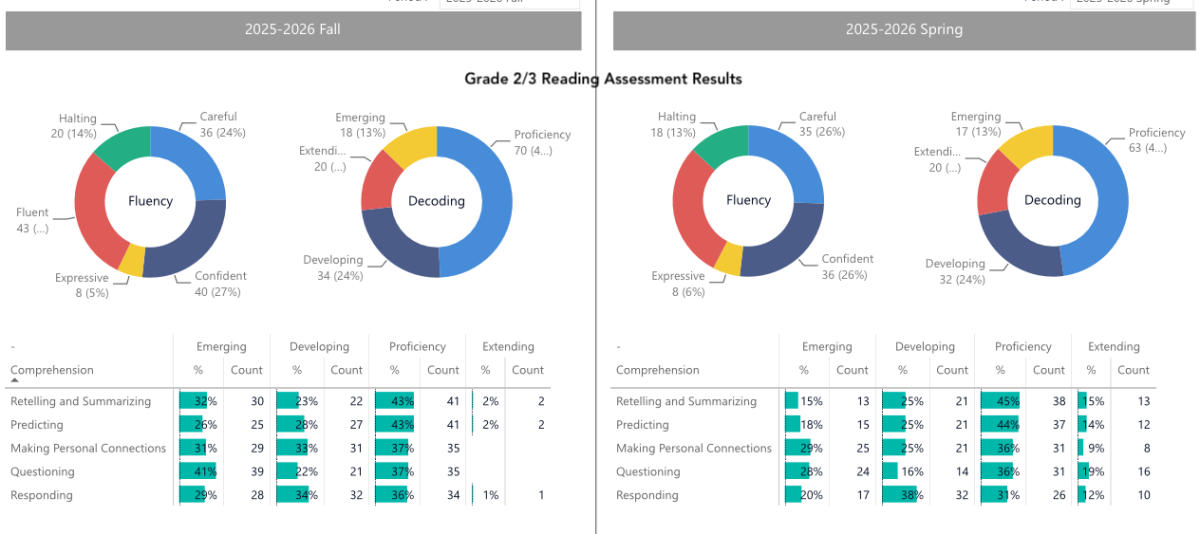
| What does the evidence tell us so far? | From our Spring RFRA results, we saw students increased proficiency in different comprehension areas when the Fall RFRA was administered, particularly in the Intermediate Grades. Of note is the overall growth in Intermediate student competency with Making Connections and Responding in the Intermediate Grades. We are seeing similar trends in the Grade 2/3 range and and overall increase in reading readiness (letter sound knowledge) in our Kindergarten and Grade 1 students. When interpreting the data, it is also important to be mindful of changes in student numbers and incoming students late in the year who participated in only the Spring Reading Assessment and would not have had the direct instruction over the course of the year that their peers had. |
| To what extent are the actions making a difference? | We are proud of how hard our students and staff have been working this year to build on and deepen their reading skills this year. There has been growth across grades in our focus areas of Making Connections and Responding (see graphics below) and we continue to work on supporting our students who are Emerging in their Literacy Skills to build proficiency in reading. Within that group continues to be our priority population of ELL Learners, particularly those at the Beginning and Developing levels of English Language Acquisition in Intermediate Grades. This will continue to be a focus moving forward. |
| How will we move forward accordingly? | Direct instruction and modelling of reading strategies will continue to be a focus in classrooms. Small group literacy support and intervention supported by Resource Teachers and Classroom Teachers will continue to be a structure used to support our students to build their reading proficiency. Intentional programming for our Intermediate-Grade Beginning and Developing ELL students will also continue to be a priority moving forward. Further information about Kindergarten and Grade 1 students SPARK and SPARK 1 data is in our June Action Post. |

Updated:
Wednesday, June 3, 2026